

The Hidden Power of Product Demonstrations: Why Showing Beats Telling
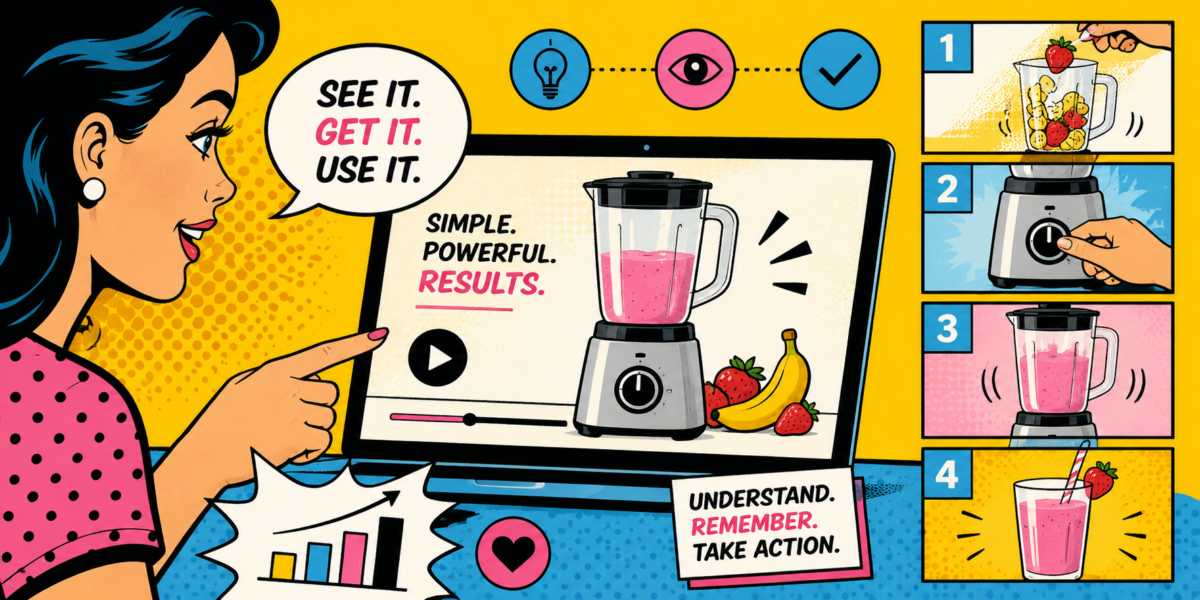 A toaster can explain itself better than a paragraph can, provided someone presses the lever.
Product demonstrations work because they remove a layer of guesswork. Instead of asking people to imagine how something functions, they let them see the action, sequence, result, and benefit in motion. That matters whether the product is a kitchen gadget, a software tool, a medical device, a learning app, or a piece of equipment with more buttons than a small spaceship.
A written description can be useful, but it often depends on the audience already knowing what to picture. A demonstration gives the mind something solid to hold. It turns "this product streamlines workflow" into "click here, drag this there, watch the report build itself while everyone in the meeting suddenly looks less haunted."
Seeing Reduces Mental Friction
People do not always struggle because a product is bad. Sometimes they struggle because the explanation arrives in the wrong form. A feature list asks the reader to translate words into actions. A demonstration performs that translation for them.This is especially important for complex products. When someone sees a step-by-step sequence, they can follow the logic without needing to decode technical language first. The brain gets to say, "Ah, that's what it does," instead of quietly opening a second browser tab to search for simpler words.
For marketers, this creates a clearer path between attention and understanding. For educators, it gives learners a model they can copy. For ecommerce sellers, it reduces uncertainty. For anyone explaining a product, it lowers the risk of a customer nodding politely while understanding absolutely nothing.
Demonstrations Build Trust Without Shouting
A good demonstration does not need to announce that a product is useful. It proves usefulness by showing the product solving a real problem. This is why a calm, practical demo can be more persuasive than a page full of enthusiastic claims.When viewers see a product in use, they notice details that would otherwise remain hidden. They can judge scale, speed, ease, texture, movement, and the number of steps involved. They can see whether the product fits naturally into a real situation or requires the user to behave like a trained octopus.
Trust grows when the demonstration feels honest. That means showing the product clearly, avoiding misleading shortcuts, and not pretending that every task takes three seconds while a smiling person stands in a room with suspiciously perfect lighting. A useful demo respects the viewer's intelligence. It says, "Here is what happens," and lets the evidence do the heavy lifting.
Animation Turns Abstract Ideas Into Something Tangible
Some products are difficult to demonstrate in the traditional sense because the most important processes happen out of sight. Software platforms, cloud services, manufacturing systems, and educational tools often rely on actions that cannot be captured with a simple photograph.This is where animation becomes valuable. A well-designed animation can reveal relationships, workflows, and outcomes that would otherwise remain invisible. Instead of explaining how data moves through a system, an animation can show the journey. Instead of describing how a mechanism operates internally, it can peel back the outer layers and reveal the process step by step.
The goal is not entertainment for its own sake. The goal is clarity. Every movement should answer a question, not create three new ones. When animation is used thoughtfully, it transforms complicated explanations into experiences that people can understand in seconds rather than minutes.
That efficiency matters because attention is a limited resource. Most audiences are willing to invest time in learning, but few are eager to wrestle with confusion.
Step-by-Step Explanations Create Confidence
Many products fail to gain traction because potential users feel uncertain about getting started. They may understand the overall benefit but remain unsure about the first few actions required to achieve it.Step-by-step demonstrations solve this problem by breaking complexity into manageable pieces. Instead of presenting a mountain, they present a path.
A strong demonstration often includes:
- The starting situation or problem.
- The actions required by the user.
- The product's response to those actions.
- The final result and practical benefit.
Educational content has relied on this principle for decades. People learn by observing examples, repeating actions, and seeing outcomes. Product demonstrations apply the same logic. They reduce uncertainty and replace it with familiarity.
Familiarity is powerful. People are naturally more comfortable with tools and systems that already feel known before they ever touch them.
Engagement Comes From Relevance
The most effective demonstrations focus on real-world situations rather than features in isolation. Viewers care less about what a product contains and more about what a product accomplishes.Showing a project management platform organizing a chaotic workload is more engaging than listing its menu options. Demonstrating a kitchen appliance preparing a meal is more compelling than discussing motor specifications. Showing a learning platform helping a student master a difficult topic often creates a stronger connection than displaying every available setting.
People respond when they recognize their own challenges in the demonstration. They begin imagining how the product could fit into their lives, workplaces, or routines.
That connection is difficult to create through description alone. Watching a solution unfold creates a stronger impression than reading about the possibility of one.
Proof Is in the Playback
Words remain important. They provide context, detail, and explanation. Yet when understanding truly matters, showing usually accomplishes what telling struggles to achieve.Visual demonstrations, animations, and structured walkthroughs help people grasp ideas faster, remember information longer, and evaluate products with greater confidence. They transform uncertainty into understanding and curiosity into action.
Whether the goal is teaching, selling, training, or informing, the principle remains remarkably consistent. When people can see a product solving a problem, they no longer have to imagine whether it works. The answer is right in front of them, doing the job instead of making promises about it.
Article kindly provided by dandifydesign.com
Latest Articles
- Why Mixing Photography Styles Can Produce a More Interesting Record of an Event
- How to Photograph a Room Without Making It Look Bigger Than It Really Is
- Why Layering a Scene Creates Wedding Photographs That Feel More Immersive
- The Quiet Design Details That Make Wedding Memories Feel More Personal
- The Psychology of Ceiling Height: How Vertical Space Changes the Way We Feel
- The Hidden Power of Product Demonstrations: Why Showing Beats Telling
- Beyond Family Portraits: Unexpected Photos That Make Stunning Wall Art
- Designing for Trust: The Hidden Visual Signals That Shape First Impressions
- Why Banner Design Is Still One of the Most Effective Local Marketing Tools
- Designing for Impatient People, and Why That's a Good Thing
- Borrowing Film Planning Techniques for Better Graphic and Web Design
- Designing with Light Instead of Filters: How Atmosphere Shapes a Photograph
- The Scent Wardrobe Principle: Designing Your Fragrance Collection Like an Interior Space
- How Small Visual Details Change the Entire Mood of an Image
- Turning Everyday Lighting Into a Design Feature
- Designing Photo Albums That People Actually Revisit
- Designing Illusions: How Sliding Wardrobe Doors Can Visually Reshape a Room
- Fit Over Fashion Why Tailoring Matters More Than Trends for Formalwear
- Why Fast Websites Matter More Than Beautiful Ones When People Are Choosing Where to Eat
- When Product Photos Quietly Sabotage Online Sales
- Architecture
- Graphic Design
- Web Design
- Industrial Design
- Interior Design
- Fashion Design
- Photography
- Product Design
- UI/UX Design
- Landscape Design
- Animation
- Industrial Engineering
- Packaging Design
- Branding and Identity Design
- Exhibit Design
- Advertising Design
- Typography
- Motion Graphics
- Sustainable Design
- User Research
- Fashion Merchandising
- Film and Video Production
- UX Writing
- Environmental Design
- Print Design
- Interaction Design
- Art Direction
- Textile Design
- Game Design
- Virtual Reality (VR) Design
- General Design Principles
- Event and Wedding Design