

The Geometry of Strength: Why Removing Material Can Sometimes Make a 3D-Printed Object Stronger
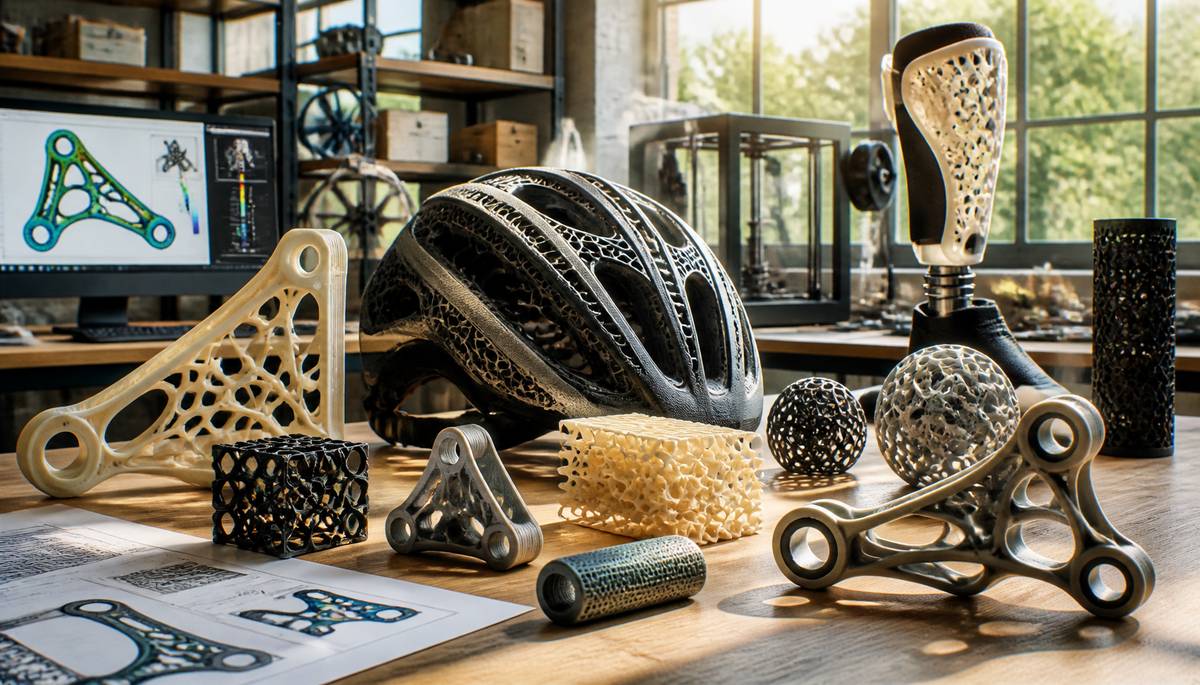 A solid block of plastic might look reassuringly indestructible, but sometimes its greatest structural weakness is that there's simply too much of it. Engineers have discovered that strategically removing material can produce components that are lighter, more efficient and, under certain loading conditions, stronger than their solid counterparts. It sounds suspiciously like an excuse to charge more for less, but the science is considerably more convincing than the marketing.
Three-dimensional printing has made this approach increasingly practical. Instead of manufacturing objects with uniform interiors, designers can create intricate networks of supports, hollow chambers and carefully positioned reinforcements. The result is a different philosophy of engineering, where the location and arrangement of material can matter more than its total quantity.
Why Solid Doesn't Always Mean Strong
Traditional thinking suggests that thicker objects should naturally withstand greater forces. Although adding material often increases absolute strength, it can also introduce unnecessary weight, manufacturing costs and structural inefficiencies. A component doesn't necessarily experience equal stress throughout its entire volume.Consider a shelf bracket supporting a heavy object. Certain regions experience substantial bending or tensile forces, while others contribute relatively little to resisting the load. Filling every available space with plastic might create a heavier bracket without providing a proportional improvement in performance.
Engineers therefore distinguish between absolute strength and the strength-to-weight ratio. A lightweight structure capable of supporting a substantial load may be more useful than a heavier alternative with greater ultimate strength. This distinction becomes especially important in vehicles, protective equipment and portable devices, where every unnecessary gram has consequences.
Lattices and the Art of Strategic Emptiness
One particularly interesting development involves internal lattice structures. These consist of repeating geometric patterns, often resembling interconnected triangles, honeycombs or three-dimensional webs. Rather than filling an object completely, designers distribute material along carefully selected pathways.Triangles are especially useful because their geometry resists deformation when forces act through their joints. Honeycomb arrangements can provide excellent stiffness relative to their weight, particularly under appropriately directed loads. More elaborate lattice designs can also absorb impacts through controlled compression.
However, not every geometric pattern performs equally well. A lattice that resists compression effectively might behave poorly when subjected to twisting or repeated bending. Its performance depends on cell size, wall thickness, material properties, printing orientation and the direction of applied forces.
Simply selecting the most impressive-looking pattern from a design catalogue is therefore unlikely to produce engineering excellence. A structure resembling an alien beehive might look magnificent, but appearances offer limited protection when a component collapses under its first serious load.
Topology Optimisation and Nature's Engineering Lessons
Topology optimisation takes material efficiency further by using computational methods to determine where material is structurally necessary. Designers specify the forces, mounting points, available space and performance requirements. Software then explores possible arrangements that satisfy those constraints while reducing weight.The resulting shapes frequently resemble bones, branching trees or other organic structures. This resemblance isn't entirely coincidental. Natural systems often develop forms that balance mechanical demands with limited resources, although biological growth involves many factors beyond structural efficiency.
A topology-optimised component might feature sweeping curves, irregular openings and thickened connections precisely where stresses concentrate. Such shapes can be difficult to manufacture using conventional machining, but additive manufacturing makes many of them achievable.
The important qualification is that removing material doesn't magically increase the inherent strength of a polymer. Instead, intelligent geometry can improve how efficiently that material carries loads, sometimes producing a lighter component with superior performance under its intended operating conditions.
Hollow Structures That Punch Above Their Weight
Hollow components offer another demonstration of how geometry can outperform brute force. Tubes, for example, can resist bending remarkably efficiently because much of their material is positioned away from the central axis, where it contributes more effectively to bending stiffness.This explains why bicycle frames, furniture supports and countless mechanical components use hollow sections rather than solid bars. A solid metal rod might appear more dependable, but a properly designed tube can deliver comparable stiffness at substantially lower weight. Apparently, even engineering has discovered the advantages of having nothing in the middle.
Three-dimensional printing extends this principle through internal ribs, reinforced shells and variable wall thicknesses. Designers can strengthen critical regions while leaving less demanding areas hollow. The challenge lies in understanding where those reinforcements belong, since poorly positioned ribs can create stress concentrations rather than eliminate them.
From Crash Protection to Medical Innovation
The practical applications of lightweight engineering extend across numerous industries. Protective helmets, for instance, can incorporate specialised lattice structures designed to deform under impact, absorbing energy before it reaches the wearer's head. Unlike structures intended primarily for stiffness, these designs deliberately sacrifice some rigidity to manage sudden forces.Automotive manufacturers can benefit from lightweight brackets, mounting components and specialised interior structures. Reducing vehicle mass can improve energy efficiency, although every redesigned component must still satisfy demanding requirements for fatigue resistance, vibration and crashworthiness.
Medical applications are particularly interesting. Certain orthopaedic implants incorporate porous structures that encourage bone integration while reducing stiffness differences between the implant and surrounding tissue. Custom prosthetic components can also use carefully distributed material to balance strength, weight and comfort.
Everyday products offer opportunities too. Bicycle accessories, ergonomic handles, footwear cushioning and portable equipment housings can all benefit from intelligent internal geometry. Nobody particularly wants a phone case that weighs as much as the phone itself.
When Less Material Becomes a Liability
Lightweight design nevertheless introduces complications. Thin walls may buckle, lattice connections can fracture, and repeated loading can gradually weaken structures that initially appear perfectly sound.Printing technology introduces additional variables. Layer adhesion, material anisotropy, manufacturing defects and printing orientation can substantially influence mechanical performance. An optimised design that performs beautifully in simulation may behave differently when manufactured using an inexpensive desktop printer.
Testing therefore remains essential. Compression, bending, impact and fatigue assessments help establish whether theoretical improvements translate into dependable physical performance. For safety-critical applications, validated manufacturing processes and appropriate regulatory standards are indispensable.
There are economic considerations as well. Complex internal structures can increase printing times, complicate inspection and make cleaning or removing trapped powder difficult. Material savings are not automatically financial savings, particularly when production requires additional quality-control procedures.
Making a Strong Case for Doing Less
The greatest advantage of geometric optimisation is not simply producing objects with impressive holes. It is understanding how forces travel through a structure and positioning material where it provides the greatest benefit.As simulation software, material science and additive manufacturing continue developing, designers will have increasingly sophisticated opportunities to create components that achieve more with less. The strongest solution will not always be the lightest, nor will the most elaborate lattice necessarily outperform a straightforward reinforced shell.
Ultimately, effective engineering means balancing strength, stiffness, durability, weight and manufacturing practicality. Removing material becomes valuable when it improves that balance rather than merely reducing the number displayed on a weighing scale. Sometimes the smartest structural decision really is knowing what to leave out.
Article kindly provided by i-am3d.com
Latest Articles
- The Geometry of Strength: Why Removing Material Can Sometimes Make a 3D-Printed Object Stronger
- Why Photographing Clothes Without People Is Surprisingly Difficult
- How Painted Skies Transform the Atmosphere of a Room
- Why a Simple Home Redesign Can Become a Plumbing Engineering Project
- Why Mixing Photography Styles Can Produce a More Interesting Record of an Event
- How to Photograph a Room Without Making It Look Bigger Than It Really Is
- Why Layering a Scene Creates Wedding Photographs That Feel More Immersive
- The Quiet Design Details That Make Wedding Memories Feel More Personal
- The Psychology of Ceiling Height: How Vertical Space Changes the Way We Feel
- The Hidden Power of Product Demonstrations: Why Showing Beats Telling
- Beyond Family Portraits: Unexpected Photos That Make Stunning Wall Art
- Designing for Trust: The Hidden Visual Signals That Shape First Impressions
- Why Banner Design Is Still One of the Most Effective Local Marketing Tools
- Designing for Impatient People, and Why That's a Good Thing
- Borrowing Film Planning Techniques for Better Graphic and Web Design
- Designing with Light Instead of Filters: How Atmosphere Shapes a Photograph
- The Scent Wardrobe Principle: Designing Your Fragrance Collection Like an Interior Space
- How Small Visual Details Change the Entire Mood of an Image
- Turning Everyday Lighting Into a Design Feature
- Designing Photo Albums That People Actually Revisit
- Architecture
- Graphic Design
- Web Design
- Industrial Design
- Interior Design
- Fashion Design
- Photography
- Product Design
- UI/UX Design
- Landscape Design
- Animation
- Industrial Engineering
- Packaging Design
- Branding and Identity Design
- Exhibit Design
- Advertising Design
- Typography
- Motion Graphics
- Sustainable Design
- User Research
- Fashion Merchandising
- Film and Video Production
- UX Writing
- Environmental Design
- Print Design
- Interaction Design
- Art Direction
- Textile Design
- Game Design
- Virtual Reality (VR) Design
- General Design Principles
- Event and Wedding Design